Respecting Emotional Connections Is As Important As Respecting Blueprints
Executive Summary
- A home often carries memories that cannot be measured in plans or drawings.
- Sentimental furniture, old fixtures and familiar corners can hold deep emotional value.
- Good interior design should find ways to preserve what matters while making the home functional and contemporary.
- At Tanish Dzignz, we begin by understanding the people, memories and lifestyle behind a home before deciding what stays, changes or goes.
Have you ever had that sinking feeling when someone casually suggests removing something from your home that means everything to you?
Maybe it is the old swing where your father used to sit every evening with his tea. A wall covered with pencil marks showing how your children have grown. Or a slightly worn cabinet that has held your mother’s sarees for decades.
To someone else, it may look old, impractical or out of place. To you, it is part of home. And that difference matters.
When we enter a home as interior designers, we are not simply working with walls, furniture and measurements. We are stepping into a space that already has a history. Sometimes that history is visible. Sometimes it is hidden in an object, a corner or even the way a family uses a particular room.
A thoughtful interior design process needs to make room for that history.
When a Design Decision Becomes Personal
I remember a client we’ll call Anjali. During our first conversation, she showed me an old marble wash basin from her parents’ home. It had a few cracks and certainly wasn’t something you would find in a contemporary interior design catalogue.
She touched it gently and told me, “This is where my father used to wash his hands after gardening. I don’t care if it doesn’t match the new design. I want it to stay.”
The contractor saw something different.
“Madam, this is outdated. Let’s break it.”
For him, it was an old basin that could be replaced. For Anjali, it was a small piece of her father’s everyday life.
We decided not to force a choice between the old and the new. The basin was restored, placed on a carefully designed pedestal and incorporated into a garden corner.
It did not need to dominate the space. It simply needed to belong. And that became the starting point for the rest of the home.
This is one of the things I value most about interior design. Sometimes the most meaningful design decision isn’t about adding something new. It is about recognising what is already there and finding the right place for it.
This is where my father used to
wash his hands after gardening.
I don’t care if it doesn’t match
the new design. I want it to
stay.Anjali, homeowner
on the old marble basin from her parents’ home
Your Home Has More Than One Kind of Blueprint
A technical drawing tells us where a wall sits, how large a room is and where furniture can be placed.
It cannot tell us that the chair near the window belonged to your grandfather.
It cannot tell us that your children measure their height against a particular wall.
It cannot tell us that a brass lamp has travelled with your family through three homes.
Those details matter because homeowners are not simply looking for beautiful interiors. They want homes that feel personal, comfortable and connected to their lives. Personalisation, functionality and a sense of individuality are especially important when creating luxury homes that are meant to remain meaningful over time.
That does not mean everything sentimental has to remain exactly as it is.
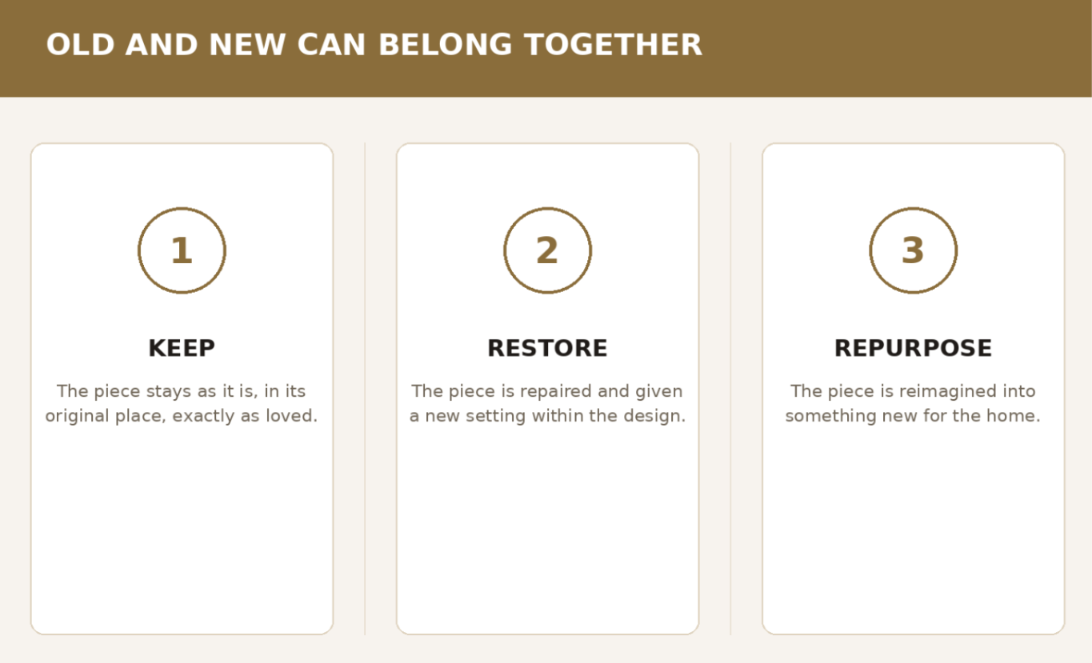
Sometimes an heirloom needs restoration. Sometimes it needs to be moved. Sometimes it can be repurposed into something completely different.
A traditional cabinet might become part of a contemporary study. An old wooden door could become a statement panel. A family photograph collection might find a new home in a carefully planned gallery wall.
The point is not to preserve everything.
The point is to understand what deserves to be preserved.
Designing Around What Matters to You
This is where the relationship between homeowner and designer becomes important.
At Tanish Dzignz, we want to understand the reasons behind your choices, not simply record the choices themselves. Our approach is built around listening, clear communication, detailed planning and creating spaces that reflect the client’s individual requirements.
So early in a project, we would rather ask:
- Is there anything in your home that you absolutely want to keep?
- Are there pieces that carry family memories?
- Are there traditional elements you would like to reinterpret?
- Which parts of your existing home already feel deeply personal?
- What would you regret losing during the renovation?
These questions can change a design completely.
They can also prevent a common problem in interior projects: creating a beautiful home that feels disconnected from the people who live there.
For a luxury interior design project, particularly in a family home, the result should feel considered rather than generic. It should combine aesthetics and functionality while still leaving room for personal history.
That is also why our work extends beyond design. Tanish Dzignz brings together interior design, bespoke furniture, project planning and execution, with an emphasis on transparency, quality and long-term relationships.
Old and New Can Belong Together
One of my favourite parts of designing a home is finding that middle ground.
A contemporary apartment does not have to erase traditional elements. A modern villa does not have to feel disconnected from the family’s heritage.
A carved wooden piece can sit comfortably against a clean architectural backdrop. A vintage object can become the starting point for a modern colour palette. Traditional craftsmanship can be reflected through a custom piece of furniture rather than reproduced literally.
The result is often much more personal than simply following a particular design style.
And this becomes especially meaningful in homes where several generations share the same space. Different family members may have different ideas of comfort, style and tradition. Good planning has to make room for those differences rather than treating them as obstacles.
If you are renovating your home, take a little time before deciding that something needs to be removed.
Ask yourself:
- Does this object carry a memory?
- Would I genuinely miss it once it is gone?
- Can it be restored or adapted?
- Can the design be planned around it?
- Could it become more meaningful in a new setting?
You may still decide that it is time to let it go.
That is perfectly fine too.
The important thing is that the decision comes from you, not from the assumption that everything old has to disappear for a home to look modern.
Your Home Is a Living Diary
If something in your home feels sacred to you, it deserves to be treated with respect.
Frequently Asked Questions